
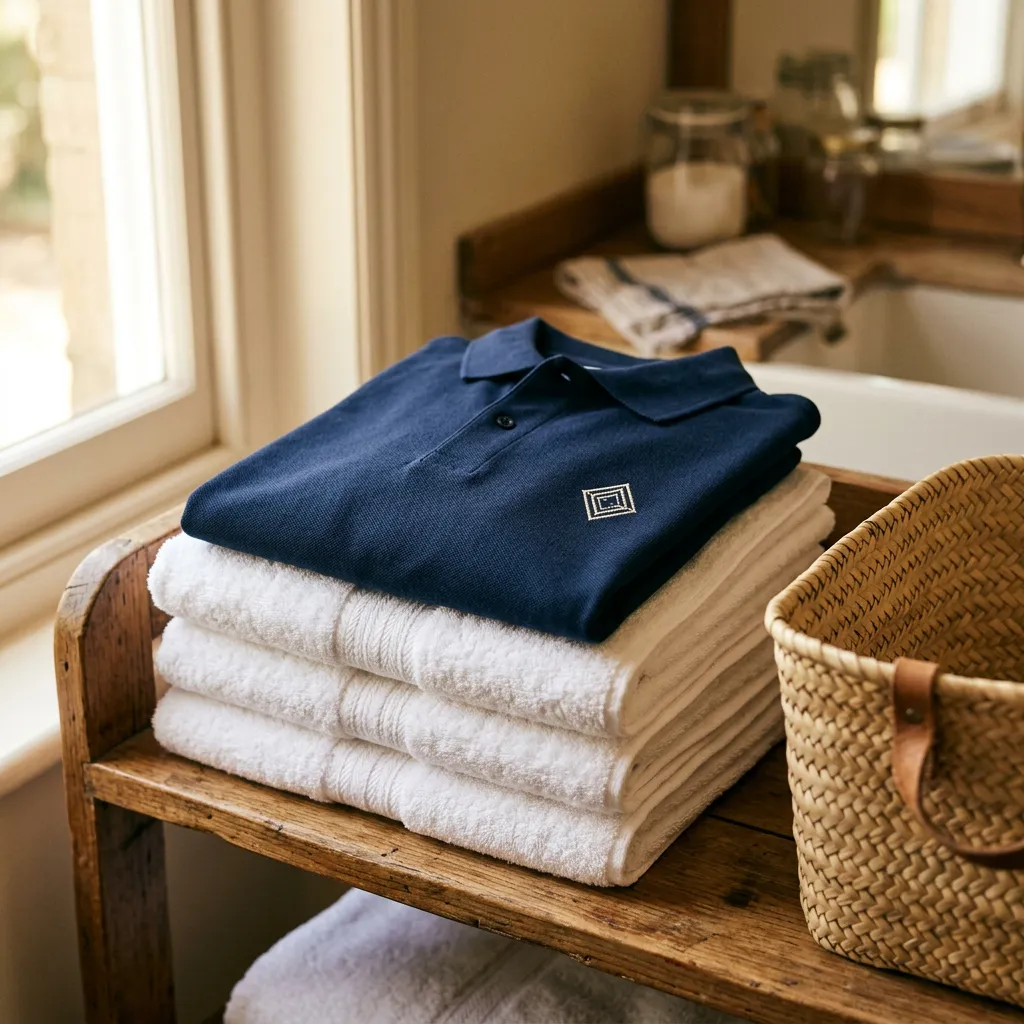
How to Wash Embroidered Shirts So the Logo Lasts
Wash embroidered shirts inside out in cold or warm water on a gentle cycle, skip chlorine bleach, tumble dry low or hang them, and press the logo only from the back through a cloth. That routine keeps the stitching flat, and it fits on a card small enough for every box in a company hand out.
Heat and friction wear out an embroidered logo. Inside out, a gentle wash, no chlorine bleach, low heat or a hanger, and no iron on the face of the stitches. Printed logos want the same routine and hats get spot cleaned. If your company is handing out the shirts, put the routine in the box, because the garment may not arrive with one.
The wash routine for an embroidered shirt
Inside out, cold or warm water, a gentle cycle and a mild detergent.
Turning the shirt inside out puts the smooth back of the embroidery against the drum instead of the raised face of the thread. On a polo, do up the buttons so the placket and collar keep their shape. Keep it away from zippers, hook and loop closures and heavy denim, which grind against the stitches.
Cold or warm water both work. Hot water is where trouble starts, because heat works on the fabric around the logo and on the backing behind it at once. A gentle cycle cuts the agitation that pulls at the thread.
Leave out chlorine bleach. It can fade colored thread and wear on the fibers around the logo. If you are fighting to keep a white polo white, we wrote up the whole routine over at PILLAR in keeping white golf polos and tees white. Fabric softener does nothing for embroidery, and on performance polyester polos we leave it out entirely.
Why a logo puckers or goes fuzzy
Puckering is the fabric moving while the stitches stay put. Fuzz is friction.
An embroidered logo is thread stitched tight into the shirt over a stabilizer backing on the inside. When high heat shrinks or relaxes the fabric, that stitched patch holds its size and the shirt ripples around its edge. That ripple is puckering, and it usually follows a hot wash, a hot dryer, or both.
Fuzz comes from abrasion. Rough fabrics and a crowded drum rub the thread until the edges of letters go soft. Inside out removes most of that contact.
Some puckering starts before laundry. A dense design on thin, stretchy fabric pulls on the garment from day one, which is why stitch count matters on lightweight fabric. The proof catches that by sizing the logo to the garment.
Drying and ironing around the stitches
Low heat or a hanger, and the iron never touches the face of the logo.
Tumble dry on low and take the shirt out while it is still slightly damp. Smooth the logo flat by hand, then hang it to finish. A shirt left baking in a hot drum is the easiest way to set a ripple around the stitches. For performance knits, this lines up with the care routine we use for performance athletic wear at PILLAR.
To iron an embroidered logo, turn the shirt inside out, lay the logo face down on a folded towel, and press from the back through a pressing cloth at the lowest setting the fabric allows. The towel lets the stitches sink in and keep their lift instead of getting crushed flat and shiny.
- Turn it inside out and do up the buttons
- Wash cold or warm on a gentle cycle
- Dry low and pull it out while slightly damp
- Press from the back, logo face down on a towel
- Chlorine bleach on any decorated piece
- Hot water and a hot dryer together
- Washing next to zippers and heavy denim
- An iron directly on stitches or on a print
Care by decoration, side by side
Every decoration wants less heat, less friction and no iron on the face. The details shift by method.
| Decoration | Wash | Dry | Iron | Avoid |
|---|---|---|---|---|
| Embroidery on shirts and polos | Inside out, cold or warm, gentle | Low heat, or hang | From the back, through a cloth, on a towel | Chlorine bleach, high heat |
| Embroidery on a structured cap | Spot clean by hand | Air dry on its own shape | Not needed | Washer, dryer, crushing the crown |
| 3D puff on a cap | Spot clean around the raised area | Air dry | Never | Hard scrubbing, heat |
| DTF transfer | Inside out, cold or warm, gentle | Low heat, or hang | From the back only | Iron on the print, high heat |
| Screen print | Inside out, cold or warm | Low heat, or hang | From the back only | Iron on the ink, chlorine bleach |
Raised logos need the lightest hand. The foam under the thread gives puff its height, and scrubbing or heat works against it. Deciding whether puff suits a cap at all? Read how 3D puff embroidery is built on a hat.
Printed logos: DTF transfers and screen prints
Treat a printed logo the way you treat embroidery: inside out, low heat, and never an iron on the ink.
DTF transfers are full color prints applied with heat, and the same heat can soften them again, so an iron straight on the print is the fastest way to damage one. Wash inside out, dry low or hang, and press only from the back.
Screen printing lays ink into the fabric and holds up well to normal laundry. Inside out protects the surface, low dryer heat keeps the ink and shirt together, and the iron stays off the print. One card covers embroidered polos and printed tees in the same pack out.
Hats with an embroidered logo
Spot clean a hat. A structured cap does not belong in the washer or the dryer.
A structured cap holds its shape with a stiffened front and a shaped brim, and tumbling plus heat can warp or crease both. Use a damp cloth with mild soap, work around the logo with a soft brush, wipe it clean and air dry it on its own shape. Sweat lines on the inside band come out the same way, so clean the band and leave the stitched front alone.
The care tag was written for the shirt. Nobody wrote one for your logo.
What the care label does not tell your team
A company program can land on desks with no care guidance anyone reads, and that is within the rules.
The FTC Care Labeling Rule guidance requires manufacturers and importers to attach care instructions to garments, and those instructions have to cover every part of the garment, trim included. The exceptions matter for a logo program. Uniforms sold to employers for employee use are exempt from care instructions, and hats are exempt too. So the polos and caps an employer hands out can arrive with no care guidance at all.
Even a label that is present can say very little. Per the FTC, a minimal label such as "Machine wash. Tumble dry." means any temperature and any bleach can be used. That is close to the opposite of what an embroidered logo wants.
Put the care routine in the box
If you are handing out the shirts, put a care card in the pack out. It is the simplest way to protect the logo you paid for.
We offer insert cards and pack outs on company programs, packed by size and name so each person opens a box with their shirt and the card on top. The card needs four lines: inside out, cold or warm, low heat, press from the back.
On a fully custom program, care text can go into the garment itself, one reason to look at care text on a custom woven label when you build from the fabric up. If you have not picked the shirt yet, start with one made to take a weekly wash, like the polos in our PILLAR line.
When a shirt wears out, the replacement should match. Reorder files are kept on record, every order gets a proof showing placement, size and thread colors, and decorated reorders for logo embroidery on stock polos run 7 to 10 business days from proof approval. One worn out polo is a normal reorder at PILLAR Prints & Embroidery, not a special request.
Washing and care questions
Can you put an embroidered shirt in the dryer?
Yes, on low heat. Turn it inside out, take it out while slightly damp and hang it to finish. High heat causes most puckering, so hanging it to dry is gentlest.
Can you iron over embroidery?
Not on the face of the stitches. Lay the logo face down on a folded towel and press from the back through a pressing cloth at the lowest setting the fabric allows.
Will bleach ruin embroidery?
Chlorine bleach can fade colored thread and wear on the fibers around the logo, so leave it out of any wash with a decorated piece. For whites, follow the garment's own care label and use only what it allows.
How do you wash a hat with an embroidered logo?
Spot clean it with a damp cloth, mild soap and a soft brush, then air dry it on its own shape. Keep a structured cap out of the washer and the dryer.
Why is my embroidered logo puckering?
Usually heat. A hot wash or dryer moves the fabric around the logo while the stitched area holds its size. A light press from the back can relax mild puckering. A dense logo on thin fabric can also pucker from the start.
Do company uniforms come with care labels?
Not always. Under the FTC Care Labeling Rule, uniforms sold to employers for employee use are exempt from care instructions, and so are hats. A care card in the pack out fills that gap.
Can you wash DTF and screen printed shirts the same way as embroidery?
Nearly the same. Wash inside out in cold or warm water, dry on low or hang, and never put an iron directly on the print.