Embroidery on Performance Polos: How to Keep the Logo Flat
Yes, embroidery on performance polos works well when the logo is sized for a light, stretchy knit, the stitch file is built for that fabric with a soft stabilizer behind it, and any big solid fill is opened up or moved to another method. If your last logo puckered, blame the setup, not the knit.
6,000
Stitches covered by standard embroidery
Source: our pricing page
$35
One time setup for a new logo
Source: our pricing page
7 to 10
Business days from proof approval
Source: our ordering terms
0
Minimum order
Source: our ordering terms
Short answer
A performance polo takes embroidery fine. Keep the mark small and open, build the stitch file for knit, back it with a soft cutaway that stays in the shirt, hoop it flat and use polyester thread. If the logo is a big full color block, print it instead.
Yes, you can embroider performance polos, with conditions
Moisture wicking knits embroider cleanly, but they forgive far less than a cotton pique.
The fabric is light, thin and made to stretch. It is also why a heavy logo fights it. A cotton polo has enough body to carry a dense patch of thread. A polyester knit does not, so every choice behind the logo has to respect the fabric.
The good news is that most company logos and golf marks already fit inside those limits. A left chest logo, a clean wordmark, a small icon on the sleeve. Done right, they stay flat wash after wash. If you are still deciding between knits, read up on nylon or polyester, over at PILLAR, before you pick a body.
And if you are still choosing the garment itself, our polo buying guide walks through fabric, fit and weight.
Why performance knits pucker
Puckering is fabric being pulled tighter than it wants to sit, and on a performance knit it almost always starts with too much thread in too little space.
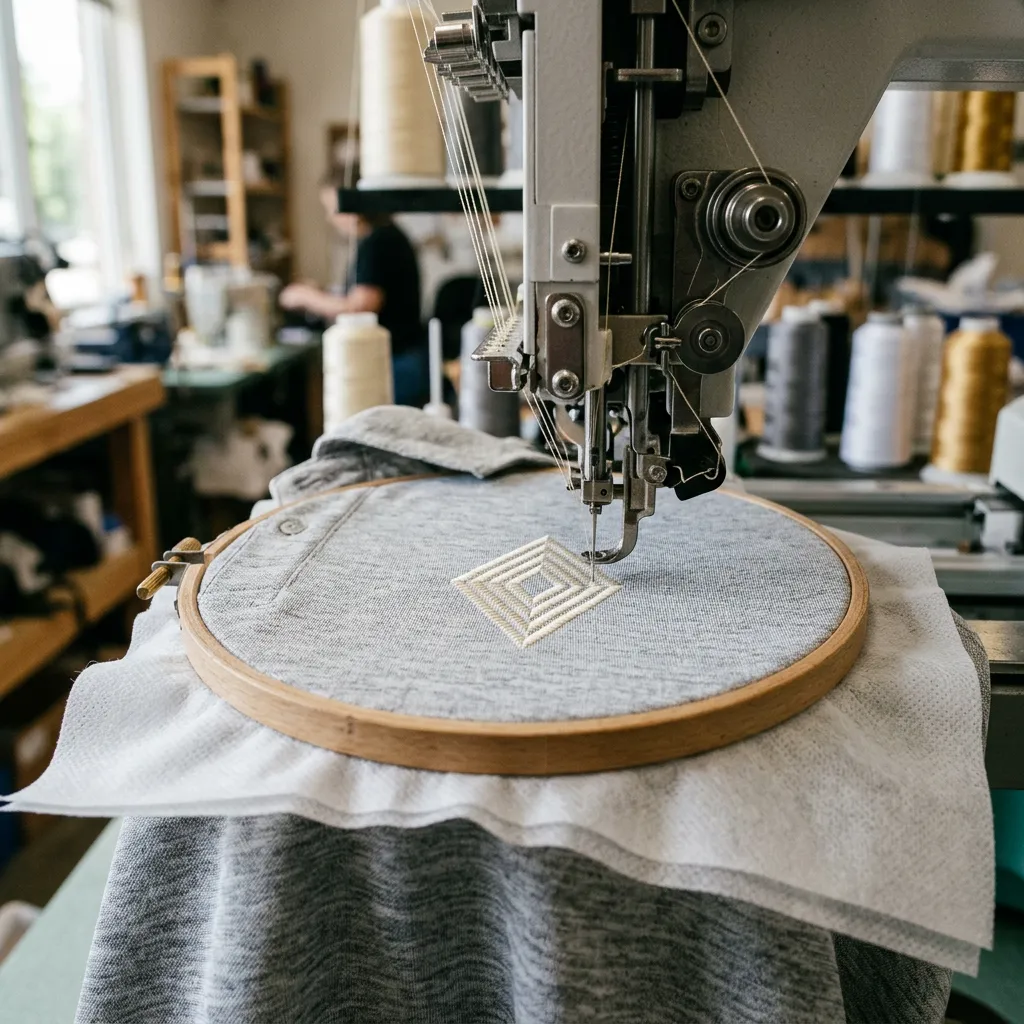
Embroidery pulls. In a dense fill, those pulls stack up in the same patch and a thin knit gathers around the edge. Hooping adds its own problem. Stretch the polo tight in the hoop and it looks perfect while it is held, then relaxes into ripples the moment it comes out. The backing decides the rest. Tear away backing is fine on stable wovens. On a knit it breaks free and leaves the stitches with nothing behind them, so the logo distorts after the first few wears.
| Cause | What you see | The fix |
|---|---|---|
| Dense fill | Fabric gathered in rings around a stiff patch | A lighter fill in the stitch file, or large solid areas opened into outlines |
| Tight hooping | Ripples that appear once the polo comes off the hoop | The garment hooped flat and smooth, never stretched |
| Backing that tears away | Fine on day one, then warped and gapped after washing | A soft cutaway or mesh style stabilizer that stays behind the logo |
| Thread that bleeds or dulls | Colors that fade or shift after hot washes | Polyester thread that holds color through frequent washing |
| Oversized logo on a thin knit | A heavy square that drags the chest and placket down | A smaller mark sized for the knit, or a different method for big art |
What a flat logo needs
A flat logo on a performance knit comes from the stitch file, the backing and the hoop working together, and no single one of them can carry the job alone.
A stitch file made for knit
Embroidery machines read a stitch file, and that file should be built for the fabric it lands on. For a performance knit that means a lighter fill, proper underlay that anchors the fabric before the top stitches go down, and pull compensation so letters and shapes do not shrink narrow as the thread draws in. When your logo is embroidered on a performance knit, the file should be made for that knit. Reorder files are kept on record, so the version that works is the version you get next time.
A soft backing that stays
A soft cutaway or mesh style stabilizer sits behind the logo and stays there for the life of the shirt. It is trimmed close to the design, so there is no scratchy square against the skin. It gives the stitches something to hold onto when the knit stretches.
A flat hoop and the right thread
The polo is hooped flat and smooth, not pulled drum tight. Polyester thread is the natural match for a polyester knit. It holds color through hot and frequent washes. We handle logo embroidery on stock polos in 7 to 10 business days from proof approval, with shipping time on top.
The fabric sets the terms. A good stitch file reads them first and is built to fit, never forced onto the shirt.
Sizing and design choices that keep it flat
The logo itself is rarely the problem, the big solid blocks of stitches inside it are.
A left chest mark sized for the knit is the safest place to start. Look at your art and find the heavy areas: a filled circle, a solid badge, a thick block of lettering. Those are what pull. Outlines, open lettering and marks with breathing room behave far better on a light fabric. For widths by garment, see the right left chest logo width for each garment before you sign off on size.
Tone on tone is worth a look too. A navy logo on a navy polo, or gray on charcoal, reads quiet and expensive.
Do
- Keep the mark small and sized for left chest
- Open up solid areas into outlines or line work
- Use open lettering with clear spacing
- Ask for the logo size in inches on the proof
Avoid
- Large filled badges and solid shapes
- Stretching a big chest logo across a thin knit
- Reusing a stitch file built for hats or jackets
- Photographic art or gradients in thread
When to use another method
If the logo is large, full color, photographic or built on gradients, stop forcing it into thread.
Embroidery is at its best with clean shapes and a few solid colors. A big multicolor graphic on a performance knit is a better fit for DTF transfers for full color art, which carry fine detail and color blends that thread cannot. For all over color on a polyester polo, look at sublimation on polyester, where the color goes into the fabric rather than sitting on top of it.
We offer screen printing too, priced on the quote like the other print methods. The method is chosen per garment, not by habit. Either way, the proof shows placement, size and thread or ink colors before production.
What embroidery on performance polos costs
Standard embroidery is priced up to 6,000 stitches, which covers most left chest logos.
Stitches over 6,000 run $1.00 per 1,000. That matters here, because a dense logo costs more and puckers more at the same time. Opening up a heavy design helps the shirt and the invoice in one move. If you want the background, read what stitch count means for your logo.
A simple example. Twenty four performance polos at the 24 to 47 tier come to 24 x $7.25 = $174.00, plus the $35 one time setup for a new logo, for $209.00. That is decoration only. The garment is quoted separately, whether it is a stock polo or one of the performance polos in our PILLAR line.
Washing performance polos with a logo
Wash cold, inside out, and skip fabric softener and high heat.
That routine is kind to both the knit and the thread. Softener coats the fibers and works against the wicking the polo was bought for. Turning the shirt inside out keeps the embroidery from rubbing against everything else in the load. Our guide on how to wash embroidered shirts covers the details. For the fabric side, read up on caring for performance wear.
Performance polo embroidery FAQ
Quick answers before you order.
Can you embroider moisture wicking polos?
Yes. Moisture wicking polos embroider well when the logo is sized for the knit, the stitch file is built for a light fabric and a soft cutaway stabilizer stays behind the design.
Why did my last embroidered polyester polo logo pucker?
Usually a mix of a dense fill, tight hooping and a backing that tore away. Each one pulls or leaves the thin knit unsupported, and together they cause ripples around the logo.
Will the backing feel scratchy against my skin?
No. A soft cutaway or mesh style stabilizer is trimmed close to the logo, so it sits flat and comfortable inside the shirt.
Does a dense logo cost more?
It can. Standard embroidery covers up to 6,000 stitches, and stitches over that are $1.00 per 1,000. Opening up a heavy design lowers the count and helps the logo sit flat.
Should I print my logo instead of embroidering it?
If the logo is large, full color, photographic or uses gradients, DTF or sublimation usually suits a performance knit better. The method is chosen per garment and priced on the quote.
How long do embroidered performance polos take?
Decorated orders on stock polos take 7 to 10 business days from proof approval, plus shipping time. There are no minimums.
Performance polos, done flat
Send the logo. We will size it for the knit.
Share your art, the polo and the headcount, and your proof comes back before anything is made.