Company Store vs Bulk Order for a Custom Apparel Program
Every large apparel program hits the same fork: open a store and let people order, or place the order yourself and hand it out. The garment you want decides it more than the software does.
In the company store vs bulk order debate, pick the garment first. If you want one fully custom standard worn by hundreds of people across locations, run scheduled drops sized from your roster. If you want a wide menu that people pay for or spend an allowance on, a store fits. Software is the easy part.
The real question behind company store vs bulk order
The real question is choice versus sameness, and stock versus custom. Search company store vs bulk order and almost every result is written by someone selling a store. That frames it as a software purchase. It is not. A store platform is software. What people actually wear is a garment, and the garment is where a company apparel program wins or loses.
So start with what you want people to look like. If the answer is one polo, one color, one label, the same at every location, you are describing a uniform. Uniforms are planned and produced in runs. If the answer is a catalog people browse, pick from and pay for, you are describing a store. Both are legitimate. They look very different in the room.
What a store gives you, and what it quietly takes away
A store gives you self serve ordering and choice. People pick their own sizes, order when they need something, and nobody in marketing has to chase a size sheet. For a scattered workforce with an allowance, that is real relief.
What it takes away is quieter. An on demand store generally draws from stock garments or inventory someone holds, so the garment menu narrows to what can be stocked. Custom fabric, a cut you designed, a woven neck label, branded packaging, all of that needs a production run, and a production run does not fit a one at a time order. Before you choose software, settle the fully custom or decorated decision, because it decides which model is even possible.
Every store order is also small and separate. Over a year, that means many little runs of decoration, each one a fresh chance for thread color, placement or blank supply to drift. A blank gets discontinued, a substitute slips in, and two people at one front desk wear two different shirts.
We think about this from the garment side because we make our own. The polos we make for PILLAR are built to one standard, and that standard only holds because every run is planned against it.
Performance pieces raise the same point. A program jacket or a warm weather layer printed with sublimation on polyester is planned around the fabric, not around whatever happens to be in stock that week.
Why a custom program runs in scheduled apparel drops
A fully custom program runs in drops because of the clock. When we build fully custom apparel made with our manufacturers, fabric, cut, color, fit, labels and packaging, it takes about 45 days door to door, with production alone running 30 to 35 days. You cannot put that behind a buy button. You plan it.
Scheduled apparel drops work like this. The launch drop is sized from the roster: every person, every location, every size. Then top up drops cover new hires, replacements and the sizes you underestimated. Each drop is planned ahead, so the clock is never a surprise.
Scale makes the case. On September 30, 2026, news reports said Kroger completed a new uniform rollout for in store employees, replacing a mix of employee selected clothing with company branded tops: a Kroger logo T shirt or polo in blue, red or black depending on the division, for nearly 400,000 employees. The stated goal was to make employees more recognizable to shoppers and create a consistent appearance across stores. That is a defined issue, not a menu.
Store, drop or one time bulk uniform order, side by side
A store, scheduled drops and a one time bulk uniform order each solve a different problem. Here is how they compare on the things that show up on the garment.
| On demand store | Scheduled drops | One time bulk order | |
|---|---|---|---|
| Garment options | Stock garments or held inventory, decorated | Fully custom or decorated stock, your call | Fully custom or decorated stock, your call |
| Labels and packaging | Usually limited to what the stocked garment carries | Woven neck labels, hang tags, branded packaging, insert cards | Woven neck labels, hang tags, branded packaging, insert cards |
| Who picks sizes | Each person, when they order | Roster collected before each drop | Roster collected once |
| Consistency across reorders | Drifts as small orders and blank supply change | Held to one approved sample every run | Strong at launch, then depends on the reorder |
| Best for | Wide choice, employee paid or allowance ordering, low volume per item | Uniform standards across many locations with steady hiring | A single event, launch or season with a fixed headcount |
Figure 1Store, drop and one time bulk order compared on the garment.
How a scheduled drop actually runs
A drop runs on a roster, a sample and a calendar.
Roster and sizes
You send headcount by location and sizes by name. If you are unsure how deep to go per person, read how many shirts each person really needs over at PILLAR before you set quantities.
Sample approval
For fully custom pieces, the pre production sample is the contract. Fabric, color, fit, label placement and decoration all get signed off before production starts. For decorated stock pieces, every order still gets a proof showing placement, size and thread or ink colors.
Production and packing
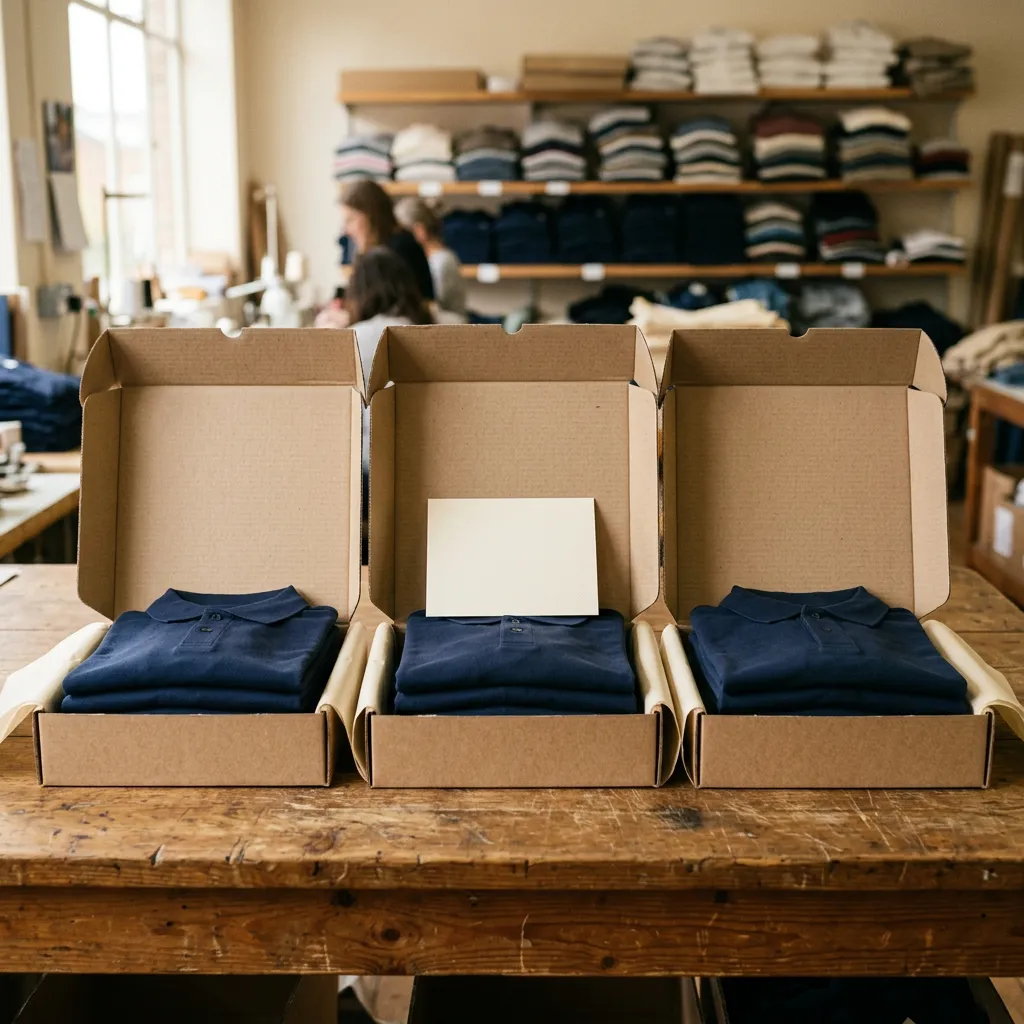
Fully custom production runs 30 to 35 days inside the 45 day clock. Decorated stock garments run 7 to 10 business days from proof approval, which makes them useful for fast top ups. Orders are packed by size and name for each location, so the box that lands in a branch office is ready to hand out. If you want the detail, here is how an order moves from proof to packed boxes.
Reorder file on record
When the drop ships, the reorder file stays on record. The next top up starts from the same specs, not from a fresh email thread.
A store sells choice. A program sells sameness, and sameness is what a brand looks like from across the room.
Keeping every drop identical
Every drop matches when every drop is held to one approved sample. That sample is the standard for color, fit, labels and decoration, and every later run is checked against it. We wrote up the process of approving the sample that every drop is held to.
Color is where programs drift first. Dye lots vary, and a blank bought a year later is not always the same color as the first one. Over at PILLAR we covered why a reorder stops matching last year's color, and the fix is the same here: custom fabric dyed to an exact color and checked against the standard.
Labels carry the standard too. The woven label that rides in every drop should read the same in drop six as it did in drop one.
When an employee apparel store is the right call
An employee apparel store is the right call when choice is the point. If you want a wide catalog of items, if people pay for their own gear or spend an allowance, if volume per item is low and orders come in small and scattered across the year, a store does that job well.
Plenty of companies run both. The core uniform runs as a planned program in drops, and a smaller on demand company store handles optional extras like hats, bags and gifts. Just be clear which pieces belong to the standard and which belong to the menu.
Questions buyers ask
Is a company store or a bulk order better for a large company apparel program?
It depends on the garment. If you want one fully custom standard worn across locations, scheduled drops sized from your roster work better. If you want a wide menu that people pay for or order with an allowance, a store fits.
Can an on demand company store carry fully custom garments?
Generally an on demand store draws from stock garments or inventory someone holds. Fully custom pieces with custom fabric, labels and packaging take about 45 days door to door, so they are planned in drops rather than ordered one at a time.
How long does a fully custom drop take?
About 45 days door to door, with production alone running 30 to 35 days. The timeline is confirmed on the first call before anything is ordered.
How do we handle new hires between drops?
Plan top up drops for new hires and replacements. For fast needs, decorated stock garments run 7 to 10 business days from proof approval, and the reorder file on record keeps the specs the same.
Is there a minimum order for a scheduled drop?
No. PILLAR Prints & Embroidery has no minimums, so a top up drop can be as small as the roster needs.
How are drops shipped to multiple locations?
We ship nationwide, and orders are packed by size and name for each location so they are ready to hand out when the box arrives.