Pre Production Sample Approval: What to Check Before Signing
The proof tells you where the logo goes. The sample tells you whether the whole program is right. Here is how a senior buyer runs pre production sample approval on a fully custom build.
Pre production sample approval is the last physical check before a fully custom run is cut and sewn. Check fabric, body color against your physical brand standard, logo placement, thread and ink colors, labels, packaging, fit and the kitting list. Send one written reply from one named approver. Each extra round moves the hand out date.
What is a pre production sample, and how is it different from the proof
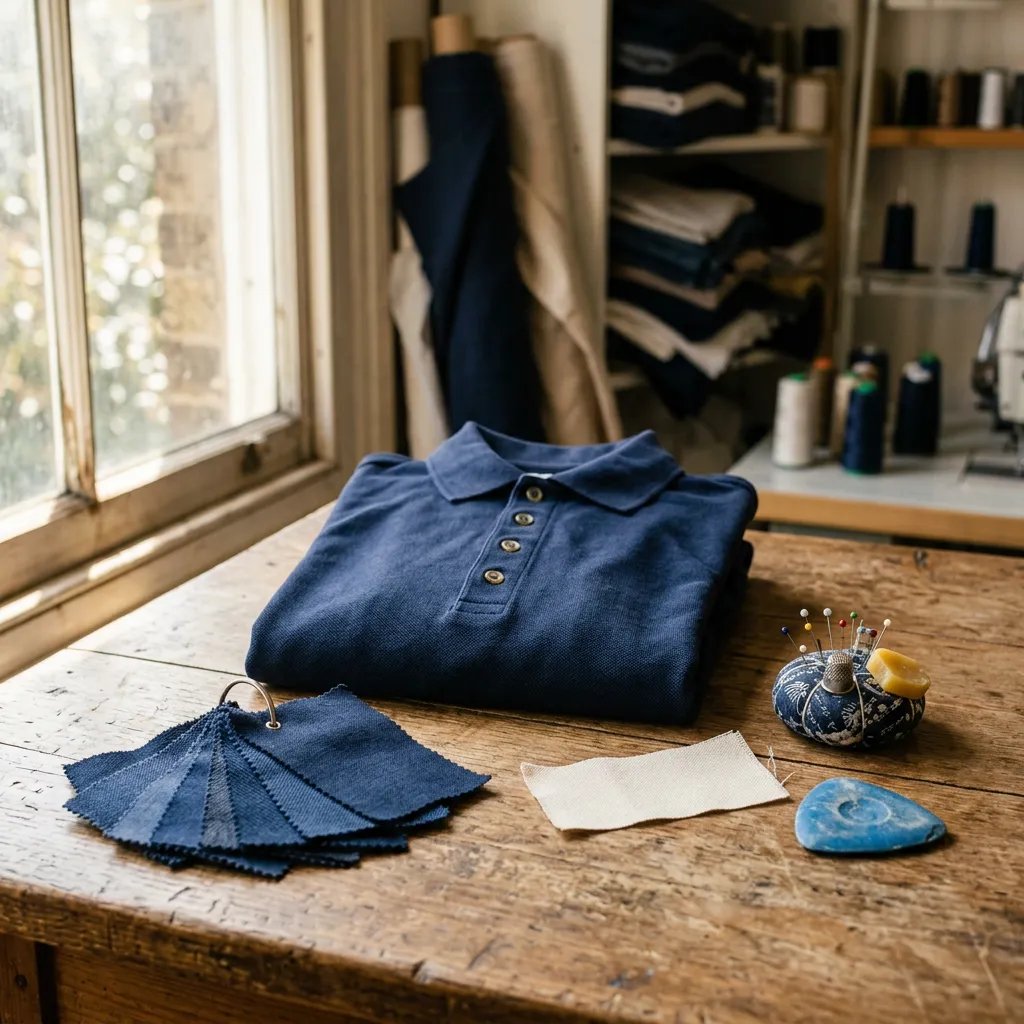
A pre production sample is the piece every unit after it gets measured against. The proof is a drawing. The sample is the garment.
Every order we run gets a proof before production. It shows placement, size and thread or ink colors. If you have never been through ours, here is how an order runs from quote to proof.
A fully custom program is different. The fabric, cut, body color, neck label and box are all made for you. A proof cannot show hand, weight, drape or how a dyed color reads in a room. That is the job of the sample, which the trade shortens to PP sample. In PP sample apparel terms, it is the approved reference: when the run comes off the line, it gets compared to that piece, not to a mockup.
Approval matters most when decisions get baked in before sewing. On one homebuilder program, an all over pattern of tools and hard hats was printed in the brand colors onto custom cut panels, and the company monogram was embroidered before the garments were sewn. Nothing on that build could be corrected after assembly, which is why locking a pattern's color before the collar is a step nobody should rush.
What to check before you sign
Check the sample against physical references, not a screen, and check every component, not just the logo.
Sample approval for custom apparel goes wrong in a predictable place: color. Monitors lie. Approve body color against your physical brand standard and look at it twice, once in daylight by a window and once under the kind of light at the venue or office where people will wear it. Custom fabric is dyed to an exact color, so the target has to be physical.
| What to check | Compare it against | Who signs |
|---|---|---|
| Fabric hand and weight | The fabric chosen in the brief and how the piece will be worn (all day event, office, outdoors) | Brand, with procurement |
| Body color | Your physical brand standard, viewed in daylight and under the venue's light | Brand |
| Logo placement and size | The approved proof | Brand |
| Thread or ink colors | The approved proof and your brand standard | Brand |
| Woven neck label and care label | Label artwork, fiber content and care wording | Brand, with procurement |
| Hang tag and packaging | Approved artwork and the unboxing you planned | Brand, with the event lead |
| Fit across the size run | Real people of different builds wearing each size | Event or HR lead |
| Name level kitting list | The roster: names, sizes and pack order | Event or HR lead, with procurement |
Printed fabric needs its own look. If the program uses sublimated performance fabric, check the print across seams and on an area that stretches, because that is where a pattern breaks or a color opens up. Fit is the row buyers skip. Put the sample on real people, not a hanger. It is the same eye we bring to the quality markers we check on our own pieces: how the collar sits, how the seams lie, whether the hem behaves.
Who signs off on the sample
One named approver signs. Everyone else feeds that person before the reply goes out.
The pre production approval process breaks down when three departments answer the same sample on three different days. Brand, procurement and the event or HR lead all belong in the approval. They belong in one message.
Set a short internal window, collect comments, photograph the exact spots you want changed and circle them, then send a single written reply. Approve in writing, by name, with the date. A nod on a video call is not an approval anyone can build a run on.
- Name one approver before the sample arrives.
- Photograph issues and mark them up.
- Check color against the physical standard in two lights.
- Approve in writing with the date.
- Approving color from a photo on a monitor.
- Comments from three inboxes over three days.
- New ideas at sample stage that belonged in the brief.
- Saying yes on a call and confirming later.
Where pre production sample approval sits on the 45 day clock
On a fully custom build, sampling and approval live in the days before production starts, and that window is small.
Our fully custom apparel made with our manufacturers runs about 45 days door to door, and production alone takes 30 to 35 of those days. Subtract one from the other and a typical build leaves roughly 10 to 15 days for design, sampling and approval. The exact timeline is confirmed on the first call, before anything is ordered, and what gets sampled and when is set on that same call.
Here is a count back for a program launching Monday, March 1, 2027. These are targets, not promises.
| Step | Owner | Clock |
|---|---|---|
| First call and brief in | You and our team | Target: by about Friday, January 15, 2027 |
| Design, sampling and the approval round | Our team, then your named approver | Roughly the next 10 days |
| Written approval returned | Your named approver | Target: about Monday, January 25, 2027 |
| Production | Our manufacturers | 30 to 35 days |
| Packed by size and name, shipped | Our team | Target: in hand for the March 1 launch |
Every extra approval round pushes that launch. If your date is closer than this math allows, ask whether you need a custom build or decorated stock. Decorated orders on stock garments run 7 to 10 business days from proof approval, so they can carry an event while the fully custom program follows on the next drop.
A sample you approve in a hurry becomes the mistake you reorder for years.
Approve the labels, packaging and kitting, not just the garment
Everything that ships with the garment is part of the approval, because all of it repeats on every reorder.
Woven neck labels, printed hang tags, insert cards and branded packaging are made to your artwork, so they need the same written sign off as the body. Read the care label wording line by line. If you are adding labels to an existing program, here is how the woven label rollout runs.
Then approve the kitting list. Orders are packed by size and name so they are ready to hand out, which means the roster you approve is the roster that gets packed. Confirm spelling, sizes and late joiners before you sign. We treat the inside of our PILLAR polos the same way: the label and the tag are part of the product, not an afterthought.
After approval, the sample becomes the standard
The signed sample and the approved proof are what the second run gets matched to.
Keep your approved sample somewhere safe and labeled. We keep reorder files on record, so the artwork, placement and thread or ink colors carry forward without starting over.
How the program lives after that is your call. Company store or one time drop, you decide. If you are still deciding whether the program should be custom at all, the stock or custom question for company polos is worth reading before the first call. Either way, PILLAR Prints & Embroidery runs it with no minimums and ships nationwide.
Pre production sample questions buyers ask
What is a pre production sample?
A pre production sample is the garment made before the full run so you can check fabric, color, placement, labels and fit in your hands. Once approved, every unit in the run is compared against it.
Is the proof the same as a pre production sample?
No. Every order gets a proof showing placement, size and thread or ink colors before production. On a fully custom build, the approval round also covers the physical piece, and what gets sampled and when is set on the first call.
Who should sign the pre production sample approval form?
One named approver. Collect comments from brand, procurement and the event or HR lead first, then send one written reply with the date and any marked up photos.
How does sample approval fit the fully custom timeline?
Fully custom runs about 45 days door to door, and production alone is 30 to 35 days. Design, sampling and approval sit in the days before production, roughly 10 to 15 on a typical build, and each extra round pushes the hand out date.
What should I compare body color against?
Your physical brand standard, not a screen. Look at the sample in daylight and under the light where people will actually wear it.
Will my reorder match the approved sample?
The approved sample and proof become the standard for the program, and we keep reorder files on record so the second run is built from the same specs as the first.
Get the sample right and every run after it follows.