Cut and Sew Apparel for Companies: How a Custom Run Works
Cut and sew apparel for companies means your garment is built from fabric to your spec (fabric, color, cut, fit and labels) instead of decorating a finished stock blank, and through us it runs direct with our manufacturers, with no minimums, in about 45 days door to door. That one sentence is the whole pitch. The rest of this page is how the run actually moves, who owns each step, and how to count back from the day your people need to be wearing it.
The short answer
Cut and sew gives your company a garment nobody else has, built from the fabric up. Production takes 30 to 35 days and the full run is about 45 days door to door, confirmed on the first call. If your date is closer than that, decorate stock instead.
What cut and sew means for a company program
Cut and sew means the garment itself is the custom part, not just the logo on it. A decorated program starts with a finished shirt off a shelf and adds your mark. A cut and sew program starts with fabric and a spec sheet, and every choice in that spec belongs to you.
Here is what you control. Fabric woven or knit to spec and dyed to an exact color, so the navy is your navy. The cut and the fit. All over print from original repeat patterns. Chest crests and sleeve hits. And the finish a buyer notices when the box opens: woven neck labels and hang tags, branded packaging and insert cards.
The garments on record are polos, hats and shirts. Polos are where many company programs start, because they get worn to meetings, trade shows and client visits. If you want the detail on what a polo manufacturer controls, from collar to placket to hem, that post walks through it.
For a sense of what a garment built to a spec feels like in hand, look at our own PILLAR polos. Same idea: a fit and a feel decided on purpose, then held.
We are not going to re argue the whole custom versus stock decision here. We already laid out choosing between a custom build and decorated stock in a full guide. Read it if your team is still split.
When decorating stock is still the right call
Decorate stock when the date is inside 45 days, when the order is a small mix of styles for a handful of people, or when it is a one time event. Logo embroidery on stock garments runs 7 to 10 business days from proof approval, and every decorated order gets a proof showing placement, size and thread colors first. That is the right tool for a lot of jobs. For a different angle on the same question, there is a short read on whether to decorate stock or build custom, over at PILLAR.
Cut and sew earns its 45 days when the apparel is a program, not a one off. A rollout to every location. A uniform that has to look identical across regions. Merch that has to read as yours from across a room.
Decorating panels before the garment is sewn
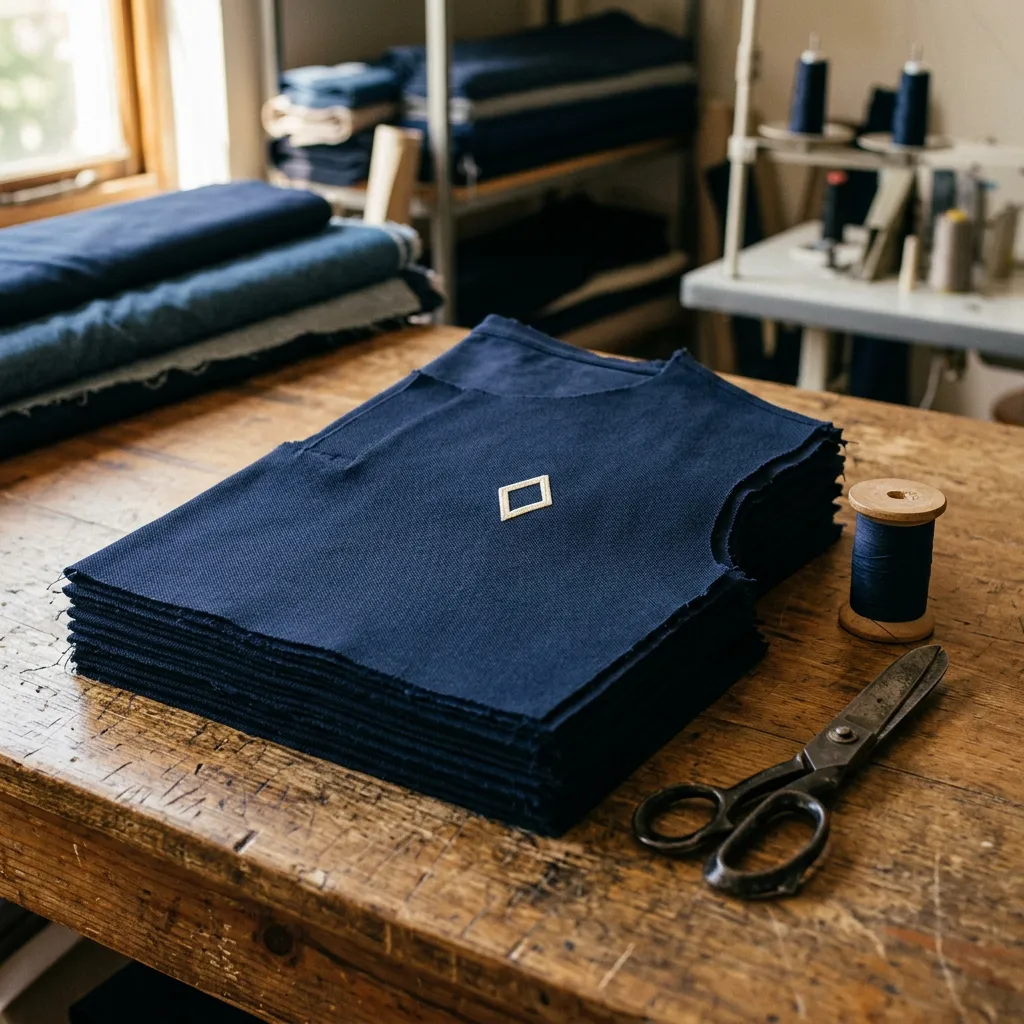
This is the advantage only cut and sew has: the decoration goes on flat cut panels before anything is stitched together. On a finished shirt, a print stops at the seam and an embroidered mark has to sit where the garment allows. On panels, a pattern can run across the seams and a monogram can sit exactly where the design says.
One example from our work. For a homebuilder, an all over pattern of tools and hard hats in the brand colors, printed onto custom cut panels, with the company monogram embroidered before the garments were sewn. The pattern lines up across the body. The monogram is placed where it was drawn, not where a finished shirt happened to have room.
Performance fabric is where this pays off most. Sublimation on performance fabric puts the color into the fiber, so a full pattern stays soft and breathable. Pair it with an embroidered crest and you have a garment that only exists for your company.
The run, step by step
The run is six steps from the first call to delivery, and only two of them have a fixed clock: production takes 30 to 35 days, and the whole thing lands about day 45. Everything else moves as fast as decisions get made. Here is the sequence for fully custom apparel made direct with our manufacturers.
- Day 1First call
We go through the garments, the headcount and the date. The timeline is confirmed on this call, before anything is ordered.
- SpecSpec and artwork
Fabric, color, cut, fit, labels, tags and packaging get locked. You send logos and brand colors, we prep the file.
- Before productionPre production sample approval
You see and approve the pre production sample before the full run starts. This is the moment to change anything.
- 30 to 35 daysProduction
The garments are cut, decorated as panels where the design calls for it, sewn, labeled and finished.
- PackingPacked by size and name, shipped nationwide
Orders arrive sorted so they are ready to hand out, with name level kitting when you need it.
- About day 45Delivery
Door to door, about 45 days from the first call.
| Step | Owner | Clock |
|---|---|---|
| First call, timeline confirmed | You and us | Day 1 |
| Spec and artwork | You send, we prep | Before production |
| Pre production sample approval | You | Before production |
| Production | Us | 30 to 35 days |
| Packed by size and name, shipped | Us | After production |
| Delivery | Us | About day 45 |
Counting back from a launch date
Take your launch date and subtract 45 calendar days. That is when the first call needs to happen. The math is simple, the discipline is not, because most programs lose time to internal sign off before anyone picks up the phone.
| Rollout date | First call by |
|---|---|
| Monday, March 1, 2027 | Friday, January 15, 2027 |
| Thursday, April 1, 2027 | Monday, February 15, 2027 |
Run it the other way too. A first call on Monday, November 30, 2026 lands about Thursday, January 14, 2027. These are planning numbers, not promises. The timeline is confirmed on the first call, once we know the garments, the fabric and the decoration.
Our advice: get the spec decisions made before the call, not during it. Know the garments, the headcount by size if you have it, and who signs off on the sample. A program with one decision maker moves cleanly. A program with five stalls at the sample.
Decide the spec once. Every reorder after that is just a date and a count.
Keeping the program identical on reorders
Reorders match because the spec does not change. Reorder files are kept on record, so the same fabric, the same color, the same cut and the same labels go back into production. Nobody has to rebuild anything from a photo of last year's shirt.
No minimums matters most here. A new hire class of eight people does not need to wait for a big order to pile up. A reorder can be small and still come back identical. If your team has been burned before and wants to understand whether a reorder will match the first order, that piece covers what holds and what drifts.
Plan reorders on the same 45 day clock as the first run. Treat the spec as a company asset, the way you treat the logo file. The program stays identical for as long as you keep ordering it.
Cut and sew FAQ
Is there a minimum order for cut and sew apparel?
No. There are no minimums, on the first run or on reorders.
How long does a cut and sew run take?
About 45 days door to door. Production alone is 30 to 35 days, and the timeline is confirmed on the first call before anything is ordered.
Can we see a sample before the full run?
Yes. Fully custom orders include pre production sample approval, so you approve the garment before production starts.
Can logos be decorated before the garment is sewn?
Yes. Panels can be printed or embroidered flat before sewing, so a pattern can run across seams and a monogram can sit exactly where the design places it.
Which garments can be built cut and sew?
Polos, hats and shirts, with your fabric, color, cut and fit, plus woven neck labels, printed hang tags and branded packaging.
What should we send for a quote?
The garments, the headcount, your brand colors and logo files, and the date people need to be wearing them.
Start with a call
Build the garment once, then reorder it.
Bring the launch date and headcount, and we will confirm the timeline before anything is ordered.