How to Start a Golf Apparel Brand: From First Polo to Launch
To start a golf apparel brand, launch one polo in two colors with your logo embroidered on a stock garment, sell through that first run, and only then invest in fully custom fabric, fit and labels.
Prove the logo and the fit on a decorated polo with no minimum. Spend on custom fabric, cut and labels once real customers have told you what to build.
Why golf is worth building for right now
Golf is worth building for because the audience is large and still growing. Green grass participation in the U.S. passed 29 million in 2025, an eighth straight year of growth, according to National Golf Foundation figures reported by Club + Resort Business. Total U.S. participants, on and off course, reached 48.1 million.
More than eight million women and girls now play on course, an all time high. That is a customer worth naming on purpose.
None of that is a reason to launch ten styles. A bigger market gives you more people to sell one good polo to. It tells you nothing about which color or sizes they will buy.
Founders who set out to start a golf clothing line often hit the minimum order wall at the first factory they call, then stretch their money across a full collection to justify the order. Ten styles means ten guesses, and every wrong guess ends up in a box.
Most first runs fail from too many styles, not too few.
Pick the one customer and the one polo
Your first customer is one specific golfer, and your first product is the polo that golfer would pull on for a Saturday round. A teaching pro selling to members has a different buyer than a creator with an online following. Name yours before you look at a garment.
A golf polo brand gets judged the moment someone tries the shirt on. Read what a golf polo has to get right, over at PILLAR, then look at the polos in our own PILLAR line to see those choices on a finished garment.
Fit
Swing in it. The shoulders have to move freely, the sleeve cannot bind at the top of the backswing, and the hem has to stay tucked through the follow through.
Fabric
Choose a performance knit that stretches, dries fast and keeps its shape after repeated washing. Very thin fabric can pucker under a dense logo, so keep the mark clean.
Collar
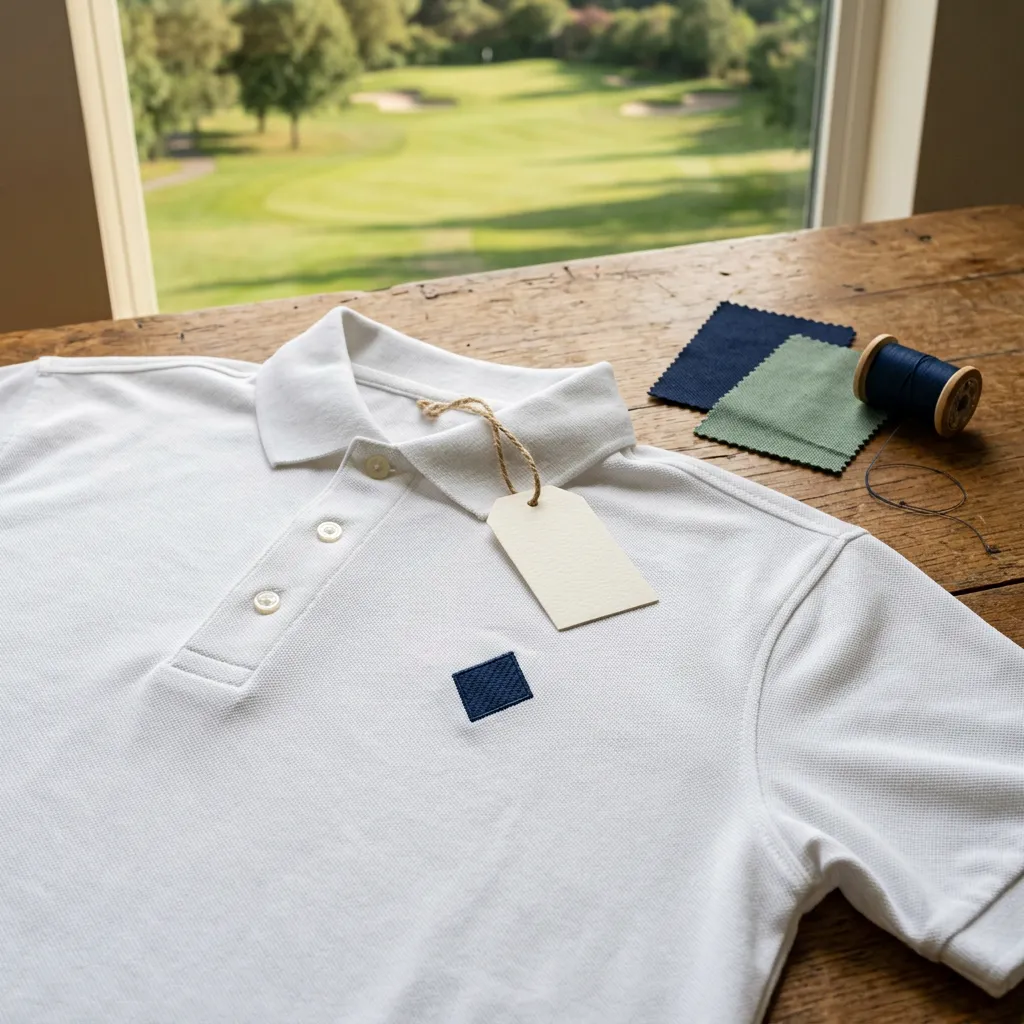
A collar that curls in the wash costs you the reorder. Look for one that still stands up at the end of the round. Then pick two colors for your first run of embroidered polos: one safe, and one with a point of view.
Two colors give you a clean read on what sold and which sizes went first.
Two ways to build the first run
Build the first run on decorated stock, and save fully custom for the moment sales tell you what to change. With logo embroidery on stock garments, decorated orders are ready 7 to 10 business days from proof approval. Every order gets a proof before production.
The other road is fully custom apparel made direct with our manufacturers, at about 45 days door to door. That is where private label golf apparel becomes truly yours, and it is a big commitment to make before anyone has bought a shirt. Figure 1 sets decorated stock against a custom build.
| Decorated stock | Fully custom | |
|---|---|---|
| What you control | The garment you choose, your logo, its placement and thread colors | Fabric, cut, colors and fit, plus labels, tags and packaging |
| Minimums | None | None, though you commit to a fabric and fit before you have sales behind them |
| Clock | 7 to 10 business days from proof approval | About 45 days door to door, production alone 30 to 35 days |
| Labels | The brand lives in the embroidery | Woven neck labels, printed hang tags and branded packaging |
| Best moment | Launch, when you are testing the logo, the fit and the demand | After a first run sells and customers have told you what to change |
Name, trademark and the label the law requires
Clear the name first, then get the label right. Search for similar names before you fall in love with one. The USPTO trademark basics explain how the search and registration process works.
Most clothing must carry a label listing fiber content, country of origin and the company name or Registered Identification Number (RN) of the manufacturer, importer or another business marketing or handling it, according to the FTC guide to textile and wool labeling. The FTC issues RNs to U.S. businesses, and one is optional, because a company name works instead. Care labels for clothing are required under a separate FTC rule.
Hats are not covered by the Textile Act labeling requirements. Wool hats are covered by the Wool Rules.
Your logo gets one useful exception. Decorative embroidery covering no more than 15 percent of the surface can be left out of the fiber disclosure with the words "exclusive of decoration".
On decorated stock, the brand lives in the embroidery. Woven neck labels, printed hang tags and branded packaging belong to the fully custom path. Whichever path you take, the required label information must stay accurate. This is general information, not legal advice, so confirm your labels with counsel before you sell.
What the first run costs to decorate
Embroidering 24 polos costs $209.00 with a new logo setup, and 72 polos cost $413.00. Both are decoration only, at standard embroidery up to 6,000 stitches, with garments quoted separately.
At 24 polos, $7.25 each comes to $174.00, plus the $35 setup. At 72 polos, $5.25 each comes to $378.00, plus the same $35. The setup is one time, and your file stays on record for reorders.
The lower rate at 72 is a poor reason to order 72. Order what you can realistically sell, and let a sellout earn the next tier. If a cap is already in your plan, 24 caps at $8.50 each come to $204.00, and a 3D puff cap logo adds $2.00 per item.
Embroidery is one line of your real cost. Build a landed cost sheet with five lines: garment, decoration, labels and tags, packaging and freight. Get every number from a quote. Then hold the finished sheet against what golfers expect to pay for a polo. If the two do not meet, change the plan before you buy.
Your launch calendar for spring golf season
For a launch on Monday, March 1, 2027, approve a decorated stock proof by Friday, February 12, 2027, or make the first fully custom call by about Friday, January 15, 2027.
On the decorated path, that February 12 approval puts your polos ready between Wednesday, February 24 and Monday, March 1, before any transit. The count skips weekends and Presidents Day. The late end of that window lands on launch day itself, so if the boxes have to travel to you, approve the proof earlier.
On the fully custom path, January 15 leaves about 45 days door to door, with production alone at 30 to 35 days and pre production sample approval on the way.
All of these dates are planning arithmetic, not a delivery promise. Your quote confirms the date.
What to add after the first run sells
Add one more color first, then a cap, and only then move into custom fabric, labels and packaging.
Reorder the winning color, retire the slow seller and test one new shade. Then add a cap under the same logo, which gives existing customers a second reason to buy without adding a size chart.
Custom comes last, once your golf apparel startup has evidence. If buyers keep asking for a longer body, a softer hand or a color no stock polo offers, write those answers into a tech pack. Custom fabric can be woven or knit to spec and dyed to an exact color, and woven neck labels, printed hang tags and branded packaging finish the job.
Golf apparel startup questions
How many styles should a new golf apparel brand launch with?
One. Launch one polo in two colors, sell through it, and let those sales decide what comes next.
Is there a minimum order to start a golf clothing line?
No. PILLAR Prints & Embroidery has no minimums, so your first run can be sized to the customers you can actually reach.
How long does a first run of polos take?
Decorated polos on stock garments are 7 to 10 business days from proof approval. Fully custom polos, built from the fabric up, are about 45 days door to door, with production alone at 30 to 35 days.
Can I add my own neck label to a stock polo?
On decorated stock, your brand lives in the embroidery. Woven neck labels, printed hang tags and branded packaging belong to the fully custom path. On either path, the required label information must stay accurate.
Will I see my logo before the polos are embroidered?
Yes. Every order gets a proof showing placement, size and thread colors before production. Fully custom orders can also include pre production sample approval.
What does it cost to embroider a first run of 24 polos?
Embroidery on 24 polos is $174.00 at $7.25 each, plus a $35 new logo setup, for $209.00. That is decoration only, and garments are quoted separately.
Send the logo, your two colors and your launch date.