Uniform Wear Test: Trial a Program Before the Full Rollout
A uniform wear test puts the candidate garments on a small group of real employees for a few weeks of normal work before you commit to the full program, so problems with fit, fabric, logo placement and washing show up on a dozen people instead of the whole company. It is the cheapest insurance a program lead can buy. Here is how we would run one.
Put two or three candidate styles on about a dozen testers across every role, fit and size for about three weeks. Score every check the same way, close feedback before your order date, then run the full program from the same logo file.
Why test a uniform before the full rollout
Because uniform programs fail on comfort and fit, not on the logo, and you only find that out once people wear the garment for real work.
A logo looks right on a proof. The trouble shows up in hour six of a shift: a collar that rubs, a fabric that holds heat, a hem that rides up. Employees rarely complain. They quietly stop wearing the shirt, and the program ends up in a drawer.
In July 2026, Delta began wear testing its new uniform with real employees wearing the pieces during day to day work, grading them on functionality, comfort and durability, with feedback that could change the pieces before mass production and a full rollout planned for 2027. Its previous uniform, introduced in 2018, drew employee complaints of skin reactions, and at one point around half of its flight attendants wore an off the rack black and white alternative instead. That is what an untested rollout can cost, and you do not need an airline budget to avoid it.
Who should wear the test pieces
Pick testers who cover every role, both fits, the full size range and the hardest conditions your people actually work in.
An office only test proves the shirt survives a conference room. Put pieces on the person who walks job sites in Arizona heat, the one beside a kitchen line, the rep who lives in airports and the lead who meets clients. Include both fits and the smallest and largest sizes, because the ends of the size run are where a cut fails.
Add at least one skeptic, who will find the problem the enthusiasts forgive. Around a dozen testers is our advice for a program of a few hundred people, not a rule. With fewer, one loud opinion can swing the result.
What to test and how to record it
Test the six things that decide whether people keep wearing the garment, and record each one the same way for every tester.
Give every tester this same short sheet.
| Check | What to look for | How to record it |
|---|---|---|
| Fit, standing and reaching | Placket gaps, a hem that rides up, tight shoulders overhead | Pass or fail, size worn, where it pulled |
| Fabric heat and breathability | How it breathes on site, in a vehicle or near a kitchen; sweat marks and cling | 1 to 5 score after the hardest day |
| Logo placement and size | How the mark reads across a room, and whether a badge covers it | Photo from ten feet, readable yes or no |
| Wash test | After several home washes: puckering, loose thread, shrink, color against the brand standard | Photos beside an unwashed piece |
| Function | Pockets, a collar that stays flat, layering under a jacket | Short note, flagged if it blocks work |
| The real signal | Anyone wearing it on a day off, unasked | Yes or no, asked at the end of the test |
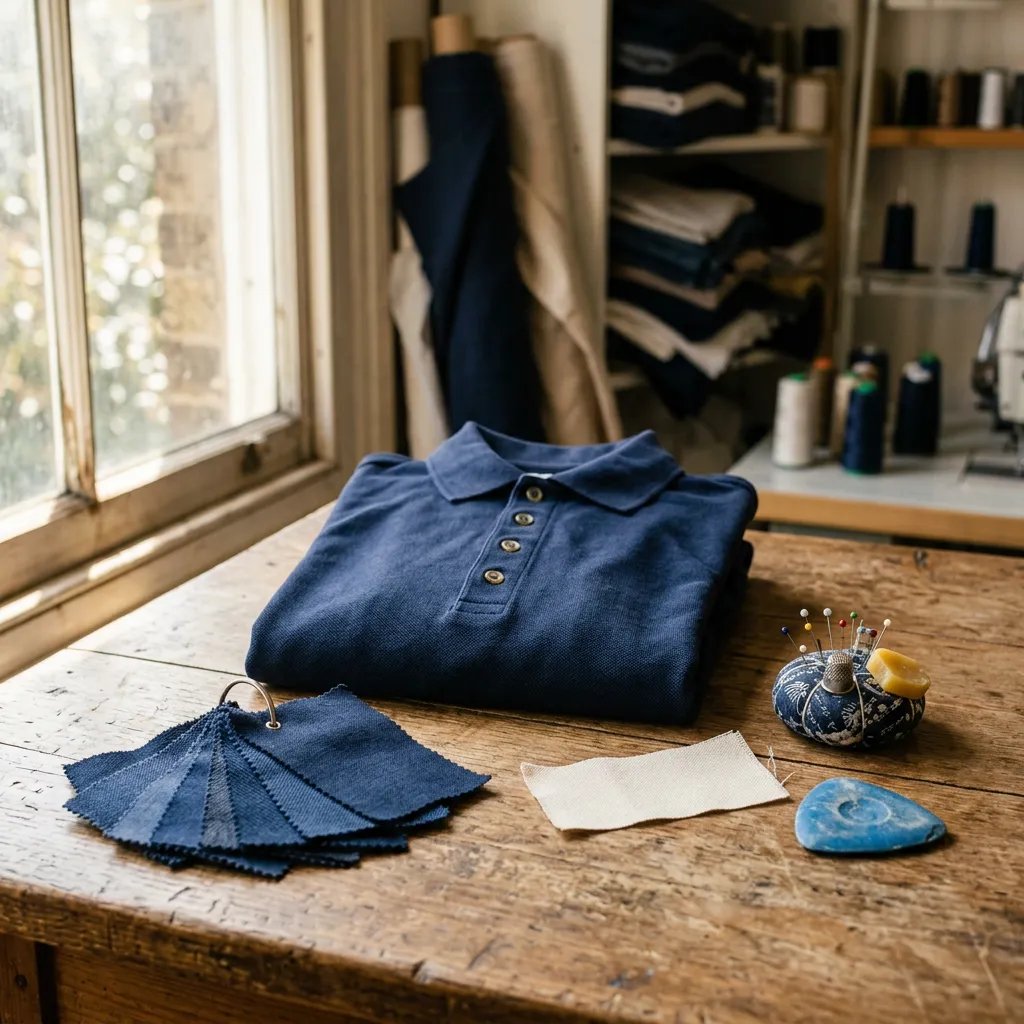
If polos are on the shortlist, test one performance knit even if the plan is cotton. The performance polos in our PILLAR line are a fair reference.
Where the test pieces come from
The test pieces come from one of two paths, depending on whether the final program is decorated stock garments or fully custom.
Path one: a decorated program on stock garments
Order the two or three candidate styles as a small decorated run. There is no minimum, so it is a normal paid order priced on our list, not a sample. Using our published embroidery pricing, 12 shirts across three styles falls in the 9 to 23 tier at $8.50 per piece on the shirts column. That is $102 for decoration plus the $35 one time setup, with the garments quoted separately. Your logo file stays on record, so the full order runs from the same file.
Logo embroidery on stock garments is ready 7 to 10 business days from proof approval.
Path two: a fully custom program
When fabric, cut, color and fit are built to spec, with woven neck labels, the real garment does not exist yet. Test the stock garments closest to the target fabric and fit first to set direction: heavier or lighter, slimmer or roomier. Then treat approving the pre production sample as the final wear check on the real build before the run.
Fully custom apparel runs about 45 days door to door, and that timeline is confirmed on the first call before anything is ordered. If you are still deciding between fully custom or decorated stock, settle it before the test.
A test calendar for an April rollout
For a Monday, April 5, 2027 rollout, approve the test piece proofs the first week of January and close feedback by mid February.
New Year's Day and Martin Luther King Jr. Day are counted off the business day clock. Every date is a target.
| Step | Target date | Notes |
|---|---|---|
| Approve test piece proofs | Mon, Jan 4, 2027 | Logo, placement and thread colors locked |
| Decorated test pieces ready | Wed, Jan 13 to Tue, Jan 19 | 7 to 10 business days from proof approval |
| Testers wear them | Wed, Jan 20 to Wed, Feb 10 | Three weeks of normal work, including home washes |
| Feedback closed | Fri, Feb 12 | Scores in, changes decided |
| Fully custom order started | By Fri, Feb 19 | About 45 days door to door |
| Rollout | Mon, Apr 5 | Packed by size and name, ready to hand out |
For a decorated program, the back half shortens, since the full order runs on the same 7 to 10 business day clock.
Testers will forgive a logo. They will not forgive a collar that rubs for eight hours.
Reading the results
Read the results for patterns, not opinions: one tester's complaint is a note, while several testers flagging the same thing is a change.
Taste will split the room. Fit and fabric problems repeat.
- Score every check the same way for every tester.
- Separate fit problems from taste before you change anything.
- Change fabric or placement when several testers flag the same thing.
- Keep the size data from every tester.
- Redesigning the logo from a few comments.
- Testing only on the office team.
- Letting the test drift past the order date.
After the test
The test hands you size data, a sequence and the language for your vendor request.
Keep every tester's size and fit notes. They are the start of your size run, alongside our guide on how many shirts per employee to order.
If the uniform arrives with a new brand, the order of operations matters as much as the garment. Over at PILLAR we covered rolling out apparel with a rebrand.
Then decide how garments reach people, because a company store or a bulk drop changes how you size and how fast the first wave lands. Finally, write the wear test into your uniform RFP, so every vendor quotes against the same plan.
Uniform wear test FAQ
How long should a uniform wear test run?
About three weeks of normal work, enough for a spread of shifts and several home washes without pushing the order date.
How many testers do we need?
Around a dozen is our advice for a program of a few hundred people, spread across every role, both fits and the full size range. Include at least one skeptic.
Is a wear test the same as a sample?
No. For a decorated program, the test pieces are a small paid order priced on our published list, with a proof before production like every order. For a fully custom program, the pre production sample approval works as the final wear check on the real build.
Does a wear test delay the rollout?
Not if you plan it backward from the rollout date. In our April example, feedback closes Friday, February 12, a week before the fully custom order needs to start.
Can we wear test a fully custom garment?
Yes, in two steps. Test the stock garments closest to the target fabric and fit to set direction, then put the pre production sample on a tester for a real shift before the run is approved.
What does a wear test cost?
For 12 embroidered shirts, decoration is $8.50 per piece on our list, so $102, plus the $35 one time logo setup. Garments are quoted separately.
Prove the uniform on a dozen people, then order for hundreds.
Send the logo, the candidate styles and your rollout date, and we will plan both orders around it.